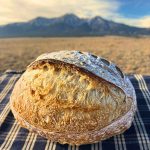
Easy High Altitude Sourdough Bread
Wild Flour Recipes | Baking at 8,000 ft
www.wildflourrecipes.com
Flavorful, tender, and incredibly easy to make. The lower hydration dough creates a more manageable texture while still delivering that classic sourdough taste and structure.
Yield: 1 loaf
Calories: 159kcal
Equipment
- Large mixing bowl or Electric Stand Mixer
- Digital Scale
- Proofing Container banneton or 9" bowl with tea towel
- Baking sheet
- Sharp Knife or Bread Lame
- Parchment paper
- Cover For Proofing Container damp tea towel, shower cap, or plastic wrap
- Baking Dish or Cast Iron Skillet
Ingredients
- 100 grams Active Sourdough Starter
- 325 grams Water
- 475 grams Bread Flour
- 10 grams Kosher Salt
- Rice Flour optional for dusting banneton
Instructions
- FEED STARTER 12 HOURS IN ADVANCE – feed the started 1:5:5 or 10 grams starter:50 grams Bread Flour : 50 grams water.
- MIX ACTIVE STARTER & WATER – mix in a large bowl until the water is creamy without chunks of starter
- ADD FLOUR & SALT– initially the dough will be dry just keep mixing. The dough will eventually become wet and shaggy. Mix for 2-3 minutes.
- REST FOR 45 MINUTES – cover with a moist towel, plastic wrap, or lid.
- COIL FOLD & REST X 4 – grab the center of the dough and pull up, allowing the edges to fall underneath, repeat another 2-3 times. Rotate the bowl 90 degrees and do 3-4 more coil folds. Cover the dough and rest for 30 minutes then repeat 3 more times.Each time you do a set of coil folds the dough will get smoother and get less sticky. BUT stop performing coil folds until the dough becomes tight or starts to tear, that is the dough indicating the gluten needs to rest.TIP: wet your hands to prevent the dough from sticking to your hands
- BULK FERMENT – cover the dough and let sit at room temperature. The amount of time needed for this will be different for each kitchen & day. Anticipate 6-10 hours.TIP: Signs of bulk fermenting being done: dough is at least doubled in size, indent stays when pressed with 1 finger, not sticky, bubbles on the surface, the top of the dough is domed, and the dough jiggles like Jell-O.NOTE: taking the temperature of your dough can help determine how long bulk fermentation will take. My dough is typically 72° F and takes around 6 hours. Warmer dough will take less time and colder dough will take longer.
- PRE-SHAPE & REST – dump the bread dough onto a clean work surface. Using a bench scraper or your hands pre-shape the dough. Gently push the edge of the dough in and away from you then rotate pushing the dough in and toward you to create a ball and tension in the dough. Continue this rotating motion until the dough is smooth on top and you create a tight ball. Rest the dough on the counter for 20 minutes.
- SHAPE – lightly flour the banneton basket or tea towel in a bowl with Rice Flour or Bread Flour. In one quick motion scoop up the bread dough with a bench scraper or your hands. Flip the dough over (the smooth surface on the bottom in the palm of your hands) and fold the dough in half. Place the dough smooth side down into the floured basket. Pinch the seam of the dough together creating additional tension to the bottom.
- PLACE IN FRIDGE – cover the dough with a moist tea towel or shower cap. Place it fridge for a minimum of 12 hours or up to 72 hours.NOTE: the longer the bread sits in the fridge the more sour taste the bread will have
- PREHEAT OVEN – preheat the oven to 450° F. Add the empty baking sheet to the oven while preheating.
- PREPARE STEAM – when open baking on a baking sheet steam needs to be added to the oven. Place a 9×13 baking dish (NOT glass) or cast iron skillet to the lowest rack of the oven. Prepare boiling water.
- FLOUR & SCORE – gently dump the dough onto parchment paper. Lightly flour the top of the dough. Cut one simple, deep cut across the dough. Add additional cuts if you want to be creative.
- BAKE – add the dough to the HOT baking sheet by using the parchment paper. Pour the boiling water into the heated 9×13 pan and immediately close the oven door. Bake 20 minutes. Then remove the pan with water and decrease the temperature to 425° F. Bake for 20 minutes or until the crust is a deep golden brown.TIP: for even baking rotate the bread 180° after 20 minutes when the water is removed from the oven.
- COOL & ENJOY! – I know its hard but allow the bread to cool completely before cutting into it.
Notes
Suggested Sourdough Timeline:
- 8 PM FEED STARTER – feed the starter 1 : 5 : 5 = 10g Starter : 50g Water : 50g Bread Flour
- 8 AM MIX – mix all ingredients and rest 45 minutes
- 8:45 AM COIL FOLD – coil fold, cover, and rest 30 minutes
- 9:15 AM COIL FOLD – coil fold, cover, and rest 30 minutes
- 9:45 AM COIL FOLD & ADD MINI CHOCOLATE CHIPS – coil fold, cover, and rest 30 minutes
- 10:15 AM COIL FOLD – coil fold, cover, and bulk ferment
- 6-10 HOURS LATER – (time dependent on dough and temperature) pre shape dough, rest 20 minutes, shape, and put into fridge
- 10 AM BAKE
Nutrition
Serving: 1of 12 slices | Calories: 159kcal | Carbohydrates: 33.4g | Protein: 4.5g | Fat: 0.4g | Saturated Fat: 0.07g | Polyunsaturated Fat: 0.18g | Monounsaturated Fat: 0.04g | Sodium: 328mg | Potassium: 47mg | Fiber: 1.2g | Sugar: 0.1g | Calcium: 7mg | Iron: 2mg